

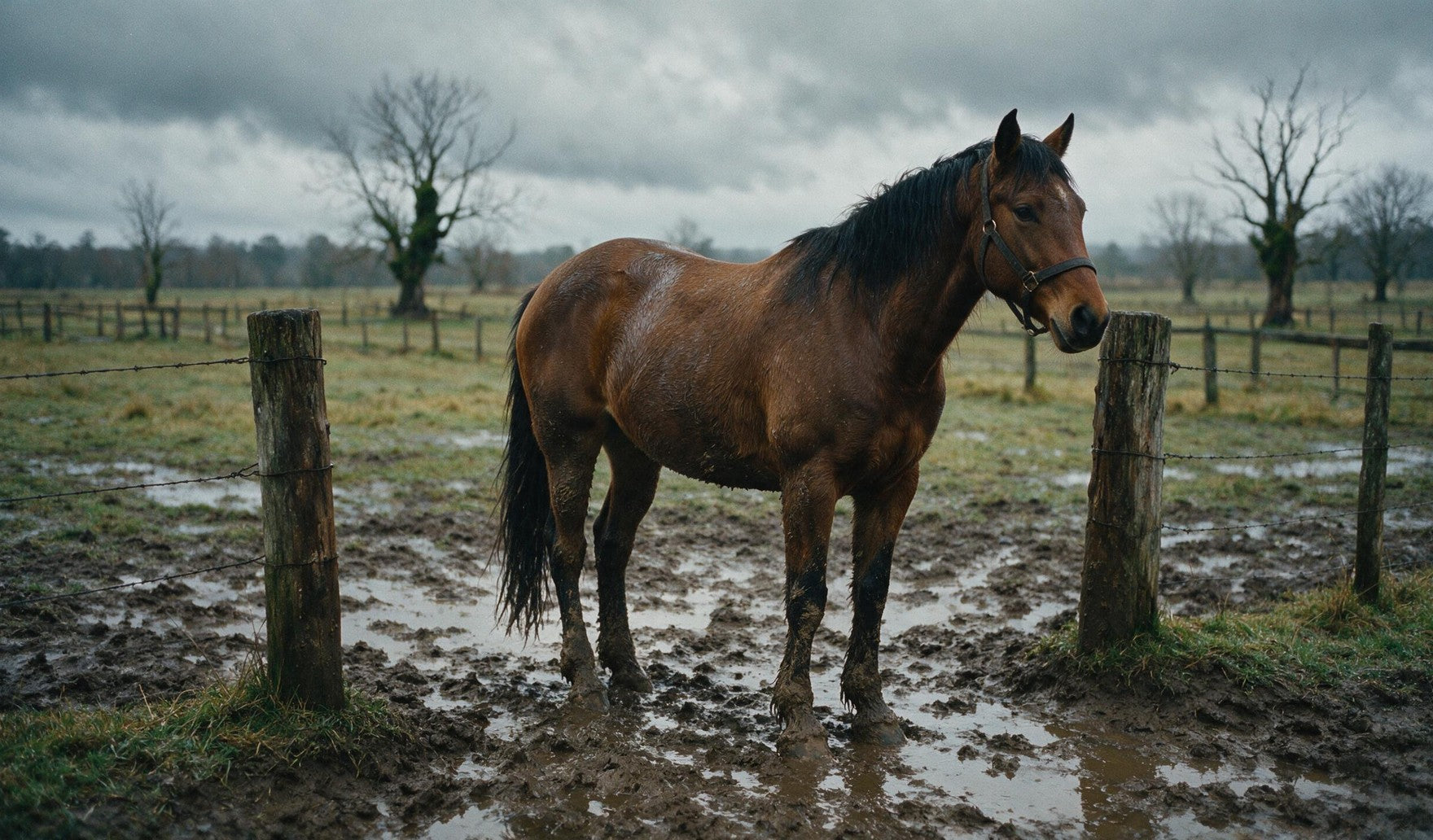
Late winter is when we hear about this most. The paddock has been wet for weeks, the gateway is churned, rugs are coming off damp, and someone notices scabs down the back of a pastern or a line of crusty lumps along a horse's back. Mud fever, greasy heel and rain scald are all skin conditions that turn up in exactly these conditions, and August into September is the window in Victoria where the ground has had no chance to dry out.
We are not vets, and this is not a treatment guide. What follows is what these conditions look like, what tends to make them more likely, what you can do about the paddock and the routine, and the point at which the phone call is to your vet rather than to us.
What are mud fever, greasy heel and rain scald?
They are commonly used names rather than precise diagnoses, and more than one thing can produce a similar-looking skin problem, which is part of why a vet's opinion matters.
Mud fever and are the names most owners use for skin inflammation on the lower leg, usually the pastern and heel, and most often on the hind legs. Broadly it is what happens when skin that has been wet and dirty for long enough loses its barrier and becomes irritated and infected.
Rain scald is the name used for similar-looking crusty lesions higher up, along the back, quarters and sometimes the neck, where rain sits on the coat for days on end. It is worth knowing that several different conditions can produce sore, scabby skin on a pastern, which is precisely why the same-looking leg is not always the same problem.
Horses with white legs and pink skin, feathered legs, and horses standing in a boggy gateway or without shelter are the ones we hear about most. That said, a horse that keeps getting it, or gets it badly, may have something else going on, and that is a vet conversation rather than a management one.
What to look for

On the lower leg, working from earliest to most obvious:
- Skin that feels warm, tight or slightly thickened when you run your hand down the back of the pastern.
- Matted hair over small crusts, which often come away with a tuft of hair attached.
- Scabs and cracked, weeping skin at the heel and around the pastern.
- Swelling up the leg, heat, or a horse that is lame or resents the leg being handled.
On the body, rain scald usually shows as raised crusty lumps along the topline and quarters, again coming away with the hair, sometimes leaving bare patches.
The last item on that leg list is the one that changes the phone call. Swelling that runs up the leg, heat, lameness, a horse that is off colour, or anything that is not clearly improving, needs your vet promptly rather than another week of washing.
Why late winter is the risk period here
Two things have to line up: wet, and long enough. A wet week is usually fine. It is the sixth week of a wet paddock, when the gateway and the water trough surround have turned to mud and the ground has not dried between fronts, that we start hearing about it.
That is exactly where Victoria sits in August. It is also when rugs have been on continuously for months, which matters, because a rug that has stopped being waterproof holds a wet coat against the skin rather than keeping it dry, and a rug worn on a wet back for weeks creates its own problem.
Reducing the risk
None of this is a cure and none of it is a guarantee. It is the management that gives skin a chance.
Give the legs a chance to dry. Skin that gets a dry spell every day copes far better than skin that never does. That might mean a few hours in a drier paddock, a stable or a shelter, or a hard-standing area where the horse can get off the mud.
Avoid wetting the legs more than you need to. Hosing every day is the instinctive response and it often works against you, because repeated wetting strips the natural oils that form the skin's barrier. Where legs are caked, letting mud dry and brushing it off is usually kinder than hosing, and if you do wash, dry the legs properly afterwards. If your vet has assessed your horse and given you a routine, follow theirs over anything here.
Manage the mud rather than the horse. Rotating the gateway, moving a water trough, adding hard standing at the gate or the feed area, or shutting off the worst corner of a paddock does more than anything you can put on the leg. It is unglamorous and it works.
Check under rugs, regularly. Take the rug off, run a hand along the back and quarters, and look. Rain scald hides under a rug for a long time. This is also the moment you find out whether your rug is still waterproof.
Keep rugs to one horse. Avoid sharing rugs between horses while a skin condition is present, because contact is one of the ways these things spread.
Keep the grooming kit clean, and separate. Brushes used on a horse with a skin condition should not go straight onto another horse.
Watch the feather. Heavily feathered legs hold moisture and hide the early signs. Whether to clip is worth discussing with your vet or farrier, because opinions differ and the feather is doing a job too.
What we would not do
We would not reach for a strong disinfectant or a household product on broken skin. We would not start pulling scabs off a sore leg, because the skin underneath is raw and it hurts, and how scabs should be dealt with is a question for whoever is treating the horse. We would not put a barrier cream over dirty, wet skin and seal the problem in. And we would not keep treating something at home for a fortnight while it slowly gets worse.
There are plenty of washes, barrier creams and dressings on the market, ours included. Used sensibly on clean, dry skin they have their place in a routine. What none of them do is replace a vet's assessment when a leg is swollen, hot, painful or not improving.
When to call your vet

Ring your vet if you see any of the following, and do not wait to see how it goes:
- Swelling that runs up the leg, or heat in the leg
- Lameness, or a horse that will not let you handle the leg
- A horse that is dull, off its feed, or has a temperature
- Skin that is not clearly improving after a few days of dry, clean management
- A horse that gets this repeatedly, which may point to something underlying
- Anything you are not sure about
Skin conditions look similar to each other and a number of different problems can produce scabs on a pastern. Getting the right answer early is cheaper and kinder than working through it by trial.
Getting your gear ready for the rest of it
Two practical jobs while you are down there.
Check whether your winter rugs are still keeping water out. If your horse comes in with a wet back under the rug, or the rug smells permanently damp, it needs reproofing or replacing before the next front comes through, and reproofing is usually far cheaper than a new rug. Our guide to washing, reproofing and storing rugs covers the whole job.
And when the rugs come off for the season, they go away clean, completely dry and in a sealed tub. A rug put away damp comes out of the shed mouldy, and a mouldy rug going onto a horse next autumn is not the start you want.
Quick answers
What is the difference between mud fever and rain scald?
They are commonly used names for skin problems in similar conditions, mud fever and greasy heel on the lower leg and rain scald along the back and quarters. Both are associated with skin staying wet and dirty for a long period.
Should I wash my horse's legs every day in winter?
Generally no. Repeated wetting and drying strips the skin's natural barrier. Letting mud dry and brushing it off is usually kinder, and if you do wash, dry the legs afterwards.
Can I treat mud fever myself?
Sensible management of the paddock, the routine and the rugs is yours to do. Anything involving a swollen, hot or painful leg, or a condition that is not improving, is your vet's.
Does clipping feathers help?
Opinions differ, and it depends on the horse. Ask your vet or farrier rather than reaching for the clippers on the basis of an article.
Our grooming, hoof care, first aid and stable and vet ranges cover the practical side of getting through a wet winter, and if you are unsure what is worth having in the cupboard, ring us on (03) 9376 5444. We will tell you what is useful, and we will tell you just as readily when the answer is a phone call to your vet rather than anything off our shelves.


