

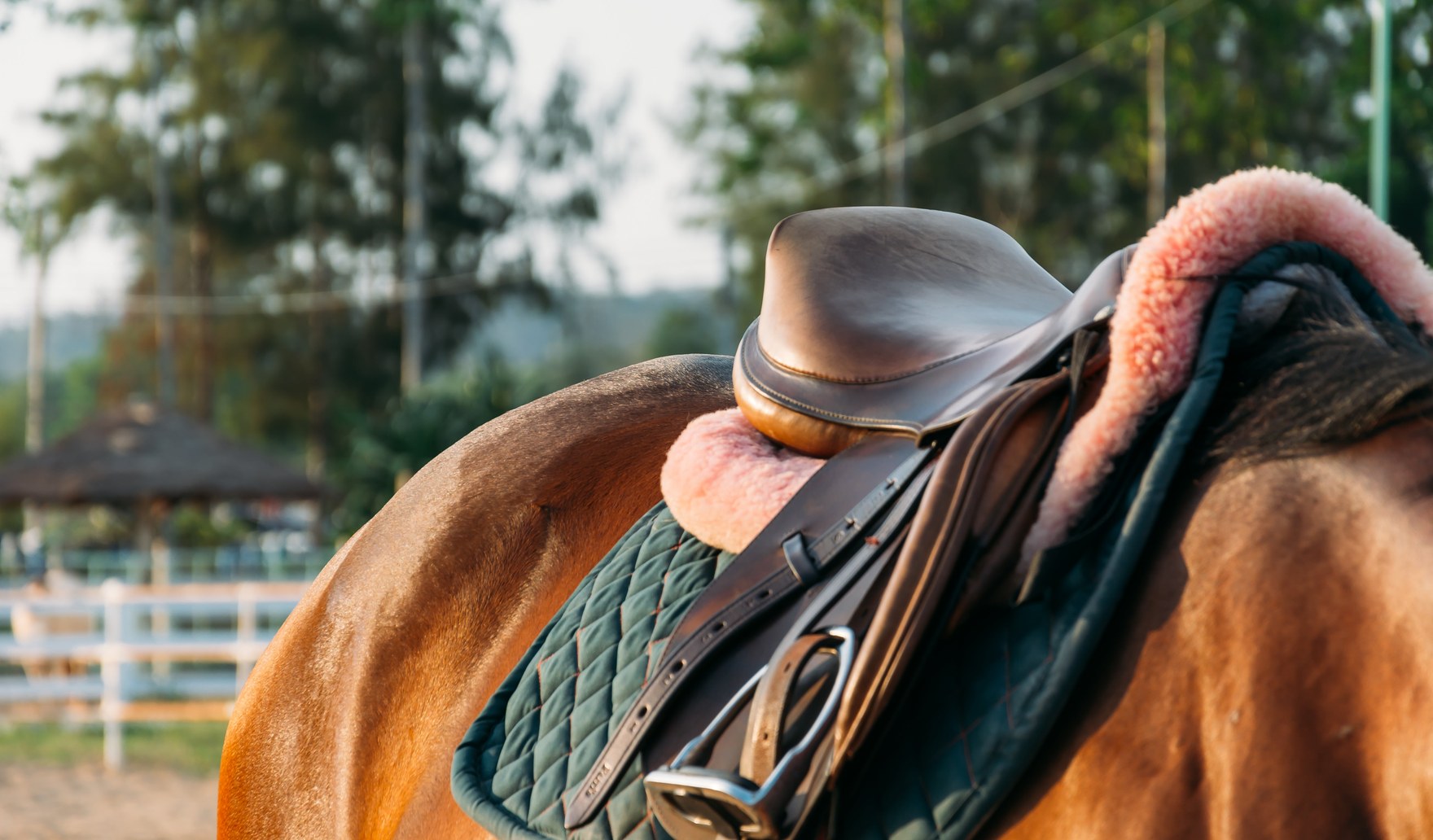
Choosing a dressage saddle involves two decisions, not one. The saddle has to fit your horse's back, and it has to position you where you need to be. A saddle can fit your horse beautifully and still be wrong for you, while a saddle you love sitting in can be quietly uncomfortable for the horse underneath you.
The right saddle creates a synergy between horse and rider, allowing both to move comfortably and perform at their best. That is the standard worth holding out for.
We have been fitting saddles in Melbourne since 1977, and the mistake we see most often is a rider choosing a brand before either of those two questions has been answered.
What makes a dressage saddle different
A dressage saddle is designed to support a balanced, upright seat with a long leg, helping your aids stay quiet and your position remain correct from schooling through to competition.
Three features do much of that work. The flap is long and straight-cut because your stirrups are longer and your knees are far less bent than they would be over a fence. The seat is deeper than a jumping saddle seat, helping to support a stable, balanced position. Most dressage saddles also use long billets, allowing the girth buckles to sit below the flap so there is less bulk under your thigh. This is why a dressage saddle takes a short girth rather than the long girth typically used with a jumping saddle.
Compared with an all-purpose saddle, a dressage saddle gives up versatility to provide a more specialised riding position. An all-purpose saddle allows you to lengthen your stirrups for dressage, but it does not support the long, upright position as effectively as a dressage saddle. Likewise, you can shorten your stirrups for jumping, but it will not support your leg and balance in a two-point position as effectively as a jumping saddle. In an all-purpose saddle, the rider often has to work harder to maintain the positions that a specialist saddle is designed to support naturally.
If you jump regularly, or you are riding at Pony Club and doing a bit of everything, an all-purpose saddle may still genuinely serve you better, and we will say so. It offers greater versatility, but that versatility comes with a compromise in the specialised support it provides for each discipline.
Fit for your horse
This is the half that matters most to the horse, so it comes first.
Gullet width refers to the width of the saddle at the front, where it sits around your horse's withers and behind the shoulders. Too narrow and it can pinch. Too wide and the saddle may drop down onto the withers. On many modern saddles, including selected Bates, Wintec and Thorowgood models, the gullet width can be changed using interchangeable gullet plates. This can be genuinely useful for a horse that is still developing, changing condition or coming in and out of work.
Channel width is different, and it is the measurement riders are often less familiar with. The channel is the space running the full length of the saddle between the panels, and it sits over your horse's spine. It needs to provide clearance along the spine from front to back, not just at the pommel. A channel that is too narrow can place pressure on the spine and the muscles alongside it, while a correctly sized channel gives your horse room to lift and move through the back.
Panels are what distribute your weight across the horse's back. They should make even contact along their length rather than bridging, where the saddle touches at the front and back but lifts through the middle, or rocking, where it pivots on a central point. PDS uses an independent panel designed to provide a high degree of adjustability, which can make it particularly useful for horses whose shape is difficult to fit with a standard panel.
Tree points should sit behind your horse's shoulder blade rather than on top of it. A saddle positioned too far forward can interfere with the movement of the shoulder on every stride, and no amount of padding will correct that.
One point is worth being clear about because it comes up every week: a thicker saddle pad will not fix a saddle that is the wrong shape for your horse. Padding may move the pressure points around, but it does not remove them.
Fit for you

Now for the half that helps determine whether you will still be happy riding in the saddle in five years.
Seat size depends on your build, leg length, the saddle model and your discipline. The same rider may need a different size in a dressage saddle than in an all-purpose saddle. Seat size is influenced by the rider's build, but leg length and the shape of the saddle are relevant too.
We do not publish a height-to-seat-size table, and we would gently suggest being cautious of anyone who does, because it allows you to skip the one step that actually settles the question. Dressage saddle seats generally range from 15.5 to 18 inches, and the best way to find yours is to sit in several.
Blocks are the next thing to consider. Knee and thigh blocks vary enormously between models, from small and unobtrusive to large and supportive. There is no single correct choice; it depends on the shape of your leg and how much support you prefer. Some riders feel secure in a large block, while others feel trapped by it.
Balance is often the thing riders describe last but notice first. A saddle that is balanced for you places your seat bones naturally in the deepest part of the seat without requiring you to work to stay there. If you find yourself constantly pushing forward or bracing backwards, the balance is wrong for you, even if every measurement appears correct.
Leather or synthetic, and what adjustability really means
Synthetic saddles are lighter, generally cost less, need very little maintenance and cope well with the weather. This makes them a sensible choice for a first dressage saddle, a Pony Club rider or anyone looking for a practical, easy-care option. Wintec and Thorowgood both offer excellent choices in this area.
Leather softens and moulds to the rider over time, generally holds its value better and, in a quality saddle, provides a feel that synthetic materials do not quite replicate. It does, however, require regular cleaning and care.
Nearly all the saddles in our range offer some form of adjustability, reflecting what riders now expect from a modern saddle. An interchangeable gullet system allows the width at the front of the saddle to be altered as a horse changes shape, develops or returns to work.
However, an adjustable gullet does not make one saddle suitable for every horse. The shape of the tree, width of the channel, panel design and overall balance must still suit the horse's back. Adjustability gives the fitter more scope to fine-tune the fit, but the underlying saddle must be the right shape to begin with.
And an honest note: if the best saddle for your horse happens to be a more affordable model, we will tell you. You are here to find the right saddle, not simply the brand you walked in asking for.
The brands we fit in dressage
Our dressage saddle range includes PDS, Bates, Wintec, Arena and Thorowgood, covering affordable synthetic saddles, adjustable models and premium leather options.
They are not interchangeable. PDS saddles are crafted in Argentina and built around an independent panel designed to offer a high degree of adjustability. Bates and Wintec are well known for their interchangeable gullet systems. Thorowgood offers a well-priced entry into a properly fitted saddle, while Arena provides an affordable leather option.
Because we fit saddles across several brands rather than representing only one manufacturer, our advice is based on which saddle best suits your horse and you, not which one we are trying to move.
We were named PDS, Pessoa and Trainers Dealer of the Year in both 2024 and 2025.
How a fitting works here

A successful saddle fitting is a two-part process, and we deliberately run it in this order.
We begin with a static fitting in store. You sit in a range of saddles and compare seat shape, size, balance, flap position and support, moving easily from one saddle to another and back again to make meaningful comparisons. Doing this in store also avoids repeatedly placing different saddles on your horse, which some horses find unsettling, and gives you time to consider the differences without feeling rushed.
You then select up to three preferred saddles that we have also identified as being most likely to suit your horse. A saddle fitter then visits you, assesses each shortlisted saddle on the horse, and has you ride in the suitable options so the fitter can evaluate horse, rider and saddle together. Any necessary adjustments can be made before you make your final choice.
Our saddle fitters cover most areas of Victoria in person. For riders elsewhere in Australia, we can provide remote fit guidance using a series of photographs and videos. We will always tell you if we believe your horse requires an in-person fitting or more precise fine-tuning.
Fitting fees vary according to the distance travelled and the type of appointment, so call us and we will confirm the cost when arranging your visit. Bookings are made by phone.
When to replace, and when not to

Not every saddle-fit problem requires a new saddle. Flocking can often be adjusted and balance corrected as your horse changes shape, which is a much smaller expense than replacing the saddle and is worth investigating before you begin shopping.
Saddle fit changes because horses change with condition, age and workload. A horse coming back into work after a spell will rarely have exactly the same back it had when it went out.
If you already own a dressage saddle and something feels different, a fit check is the sensible first step. Our guide to saddle fitting explains what happens during one.
Quick answers
How much should a dressage saddle cost? Enough to fit properly. Synthetic saddles generally start at a considerably lower price than leather saddles, but a well-fitted affordable saddle beats a poorly fitted expensive one every time. Every saddle we sell ships free Australia-wide, and flexible finance options are available.
What size dressage saddle do I need? It depends on your build, leg length and the particular model. The same rider may need different sizes in different saddles, so sit in several rather than relying on a chart.
Can I use a dressage saddle for jumping? You can use a dressage saddle to pop over the occasional small jump, but its long, straight flap and deeper seat will not support your leg or help you maintain the correct position over a fence. If you regularly do both dressage and jumping and having separate saddles for each discipline is not an option, an all-purpose saddle is the more suitable compromise.
Do I need a saddle fitting to buy online? Not necessarily. Send us photographs and video of your horse first, and we can help narrow down the suitable options before you spend anything.
Whether you are buying your first dressage saddle or replacing one that no longer suits your horse, everyone is welcome here, regardless of experience. Call us on (03) 9376 5444 or come and see the full saddle range in Flemington.


![Arena Dressage High Wither Saddle Black [:43cm 17.0"]](http://www.ascotsaddlery.com.au/cdn/shop/files/20350505_1.jpg?v=1746440456&width=600)
![Arena Dressage High Wither Saddle Brown [:43cm 17.0"]](http://www.ascotsaddlery.com.au/cdn/shop/files/20350512_1.jpg?v=1746440479&width=600)
![Arena Dressage Mono Flap Saddle Black [:43cm 17.0"]](http://www.ascotsaddlery.com.au/cdn/shop/files/20460228_1.jpg?v=1762135339&width=600)
![Arena Dressage Mono Flap Saddle Brown [:43cm 17.0"]](http://www.ascotsaddlery.com.au/cdn/shop/files/20460235_1.jpg?v=1762137677&width=600)
![Arena Dressage Saddle Black [:43cm 17.0"]](http://www.ascotsaddlery.com.au/cdn/shop/files/20341121_1.jpg?v=1746440319&width=600)
![Arena Dressage Saddle Brown [:43cm 17.0"]](http://www.ascotsaddlery.com.au/cdn/shop/files/20350499_1.jpg?v=1746440436&width=600)
![Bates Dressage Saddle Cair Classic Black [:42cm 16.5"]](http://www.ascotsaddlery.com.au/cdn/shop/files/20124168_1.jpg?v=1746405999&width=600)
![Bates Dressage Saddle Cair Classic Brown [:40cm 16.0"]](http://www.ascotsaddlery.com.au/cdn/shop/files/20273279_1.jpg?v=1746419683&width=600)
![Bates Dressage Wide Saddle Cair Classic Black [:42cm 16.5"]](http://www.ascotsaddlery.com.au/cdn/shop/files/20420673_1.jpg?v=1746466943&width=600)


