

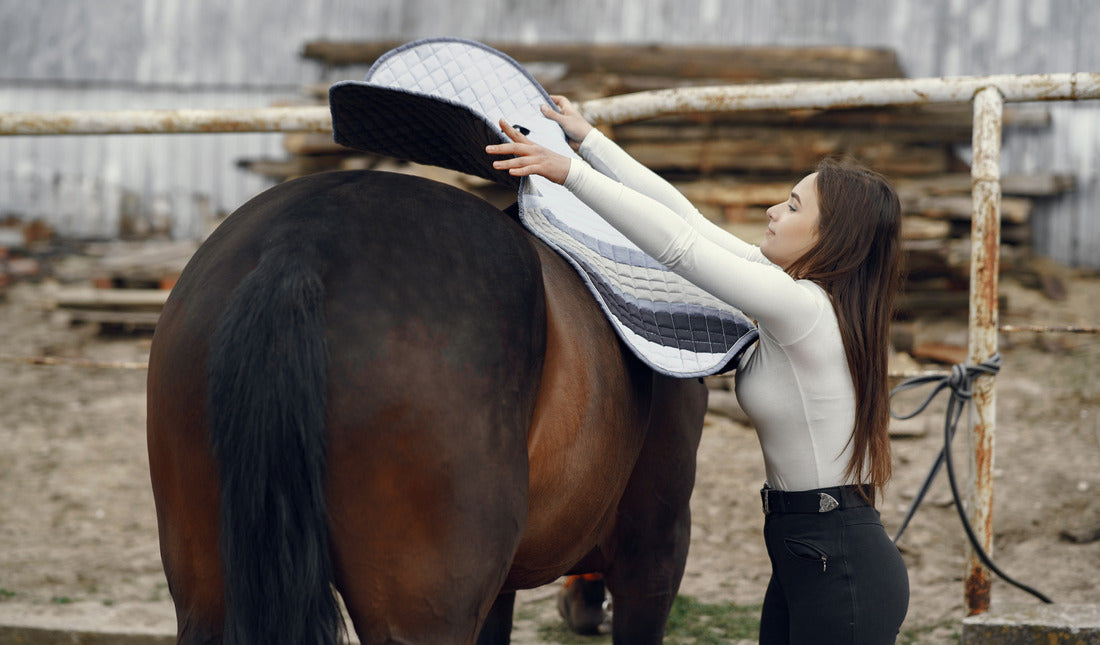
What goes under your saddle is there to keep the saddle clean and absorb sweat. That is its main job, and it is worth keeping in mind when choosing a saddlecloth, as any saddle fit concerns are best left to a saddle fitter.
Choose the shape to match your saddle, the size to match your horse and the material to suit how often you can wash it. If your horse needs more than that, it is time to consider the saddle rather than the cloth.
Saddlecloth, numnah, saddle pad or half pad?

These words are often used interchangeably in Australia, which can make shopping less straightforward.
- A saddlecloth is the square or shaped cloth that sits between the saddle and horse. Most riders use one every ride.
- A numnah serves the same purpose, but is shaped to the outline of the saddle rather than being square.
- A saddle pad in general use often means the same thing, although it can also refer to something thicker with a shock-absorbing purpose.
- A half pad is a shorter pad used in addition to a saddlecloth and sits under the saddle's panels. Half pads, including sheepskin and gel, are used for cushioning or, with shims, for minor adjustments to balance. Adjustments of this kind are best left to a fitter.
For your first one, start with a saddlecloth in the right shape for your saddle. The other options can be considered later if needed.
Which shape do I need?

The shape should follow the cut of your saddle, allowing the cloth to sit neatly under the flap without bunching or protruding awkwardly.
Dressage cloths are cut long and straight to match a dressage saddle's long, straight flap, which is why a dressage saddle pad looks so different from the others on the rail. Jump cloths, sold as jumping saddle pads by some brands, are cut shorter and further forward to follow a forward-cut flap. All purpose clothes sit between the two and suit general purpose saddles, which are what most riders at home use. Start by choosing the right shape for the saddle; selecting the colour is the easy part.
Sizing generally runs from pony to cob and full. The cloth should extend far enough beyond the saddle to protect the horse from the edge of the panel, without being so large that it flaps about.
How thick should a saddle pad be?
A relatively thin pad is usually the right choice, and this point is worth careful attention.
A thicker pad will not make a saddle that is too narrow fit. If a tree is pinching, adding padding is like wearing a thicker pair of socks with shoes that are already tight. Padding may move the pressure points around, but it does not remove them, and it can make a snug saddle tighter.
The reverse can also apply and is less widely understood. A saddle that is slightly too wide can sometimes be helped in the short term by a fitter using a correctly chosen pad or shims, and pressure research on too-wide saddles has examined this. However, it requires a fitter's judgement about a specific saddle on a specific horse. It is not a general shopping rule, and the same research shows that the effect varies with the pad. Choosing without that assessment can shift the problem rather than resolve it.
Our guidance is to use enough cloth to keep the saddle clean and absorb sweat. If you are considering extra thickness to address a comfort problem, book a fit check instead.
How should a saddlecloth sit?

There are three things to check, and together they take about ten seconds..
Pull it up into the gullet before you do the girth up. The cloth should be lifted clear of the wither and spine, forming a channel under the saddle rather than pulling down tightly across the withers. A cloth lying flat over the wither presses on it with every stride.
Sit it far enough forward, then let the saddle settle it back. Position the cloth slightly forward of where it will finish, place the saddle, then slide both back together into position so the hair lies flat underneath.
Check for wrinkles and folds after girthing, paying particular attention beneath the panels and around the girth straps. A fold under a panel creates a pressure point.

What are saddlecloths made from?
Cotton and quilted cotton are practical everyday choices. They are breathable, washable and suitable for most riders during schooling and competition.
Sheepskin, whether natural or synthetic, is used for cushioning and wicking and is popular on jump and dressage cloths. Natural sheepskin needs a particular care routine: use a wool wash rather than ordinary detergent, cold water, and dry it flat in the shade rather than in direct sun or over a heater. Heat and harsh detergent can harden the leather backing and flatten the wool, and once that happens the pad is finished. As always, read the label first.
Wool felt is another material worth knowing about, although it is intended for a different saddle. Felt pads are the western standard, cut thick and round or square to suit a western tree, and they are not interchangeable with an English saddlecloth. If you ride western, that is the type you need, and something like the Oregon round wool felt pad provides the right starting shape rather than any of the English shapes covered in this article.
Technical foams and gels are used in half pads for shock absorption, although marketing claims deserve careful consideration. When researchers tested four pad materials (gel, leather, foam and reindeer fur) beneath a correctly fitting dressage saddle on sixteen horses, only the reindeer fur pad significantly reduced the overall force on the horse's back. The other three did not produce a significant change. Half pad research has found similar variability. A pad may help, but no pad reliably transforms what is happening beneath a saddle, and the result depends heavily on the saddle above it.
Whatever you choose, keep it clean. A stiff, sweat-caked cloth containing dried mud can cause skin problems, including a rub on the wither or a sore behind the elbow. The same cold, gentle principles outlined in our guide to washing rugs apply here: check the care label, wash cold and avoid hot water on anything made with a technical fabric or sheepskin.
Where possible, keep each cloth for one horse, and never share a cloth between a horse with a skin condition and one without.
When is the saddle pad not the answer?

Dry patches within an otherwise even sweat mark, rubs at the wither, new white hairs beneath the saddle area or a horse that has become resistant are unlikely to be resolved by a different cloth. These are signs of possible saddle fit concerns and are worth investigating properly.
The same guidance applies to a saddle that will not remain in position or slips to one side. The cause may be saddle fit, the girth, rider balance or the horse's own asymmetry, and adding a pad can mask the issue rather than resolve it.
Horses change shape with condition, age and workload, so a saddle that fitted last autumn may sit differently now, particularly on a horse returning to work after a spell. Our guide to saddle fitting explains what a fitting involves and what these signs mean.

Quick answers
What is the difference between a saddlecloth and a numnah?
A saddlecloth is usually square or rectangular, while a numnah is shaped to the outline of the saddle. Both perform the same job.
Do I need a half pad?
Most horses do not need one for general riding. Half pads provide cushioning or, with shims, fitter-guided adjustments, and research shows that their effect on pressure varies rather than being reliably beneficial.
Will a thicker saddle pad fix a saddle that does not fit?
No. Padding moves pressure points around rather than removing them, and it can make a tight saddle even tighter.
What size saddlecloth do I need?
First match the shape to your saddle's cut, whether dressage, jump or all purpose, then choose pony, cob or full sizing to suit your horse.
Wool or felt, which is better?
They serve different purposes. Sheepskin and wool linings provide cushioning and wicking beneath an English saddle, while wool felt pads are the western standard and are cut for a western tree. Match the pad to the saddle first, then consider the material.
Why does my saddlecloth press on my horse's wither?
This happens when the cloth has not been pulled up into the gullet before girthing. Each time you saddle up, lift it clear of the wither and spine.
How often should I wash a saddlecloth?
Wash it regularly. A stiff, sweat-caked cloth can cause rubs, so use a cold, gentle wash and check the care label first.
Where to start
Our saddlecloths and saddle pads range includes dressage, jump and all purpose shapes in cotton, quilted and sheepskin options. The Bates all purpose saddlecloth is a hard-wearing everyday option, the Dazzle all purpose cloth is a good-value schooling choice, and the Grainge sheepskin dressage saddlecloth suits riders looking for sheepskin against the horse.
If you are choosing a cloth because something is not sitting correctly, ring us on (03) 9376 5444 before buying. We have been fitting saddles in Melbourne since 1977 and can usually help you determine whether the saddle, girth or cloth is responsible before you purchase replacements for all three.
Sources
- Kotschwar, A.B., Baltacis, A. and Peham, C. (2010), The effects of different saddle pads on forces and pressure distribution beneath a fitting saddle, Equine Veterinary Journal 42(2):114-118. https://pubmed.ncbi.nlm.nih.gov/20156245/
- Kotschwar, A.B., Baltacis, A. and Peham, C. (2010), The influence of different saddle pads on force and pressure changes beneath saddles with excessively wide trees, The Veterinary Journal 184(3):322-325.
- Effect of a Half Pad on Pressure Distribution in Sitting Trot and Canter Beneath a Saddle Fitted to Industry Guidelines, Journal of Equine Veterinary Science. https://www.sciencedirect.com/science/article/abs/pii/S0737080620303981


