

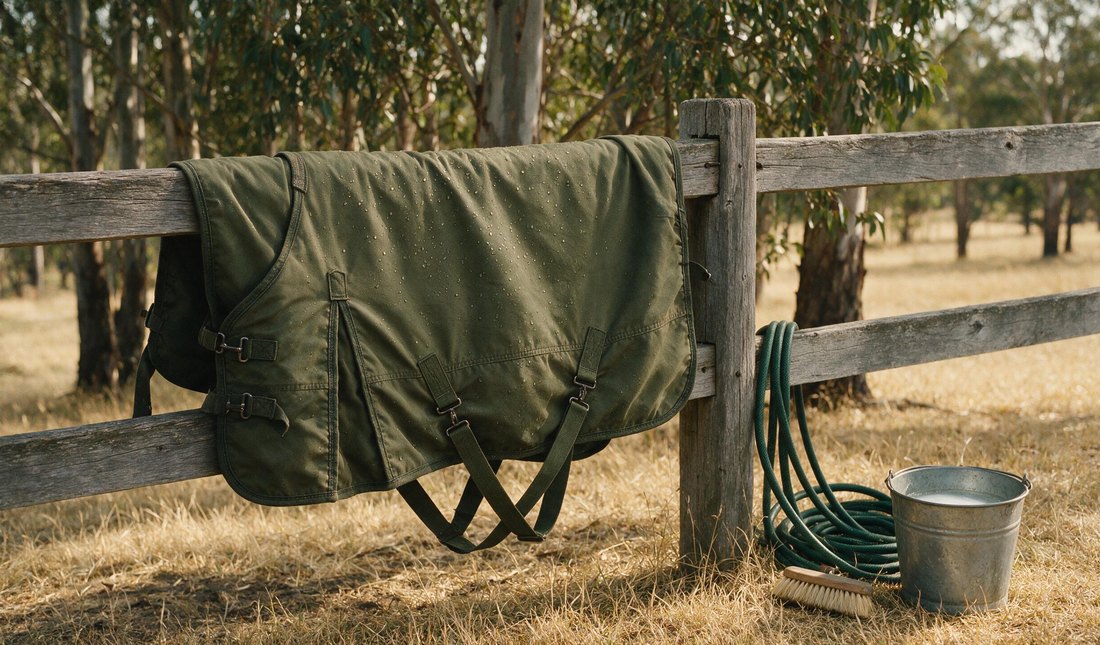
Check the care label before putting your horse rug anywhere near a washing machine. It may sound like the less interesting answer, but it is the only rule that holds across every rug we sell. Care instructions vary between manufacturers, fabrics and even two rugs that look much the same on the rail. Some rugs are labelled machine washable and are perfectly suited to a domestic machine. Many others will lose their waterproofing on the first hot cycle.
The label comes first, and everything below offers general guidance for times when the label is missing, faded or silent.
Can you wash horse rugs in a washing machine?

It depends on the rug, and its care label will give you the right guidance.
As a rough guide, cotton and mesh summer rugs usually cope well with a cold, gentle cycle. Waterproof synthetic and ripstop rugs need more care, because hot water and ordinary laundry detergent can break down the waterproof coating and affect breathability, while buckles and leg straps are hard on a domestic drum. However, fabric alone does not provide a firm rule. Some synthetic and canvas rugs are explicitly made to be machine washed, and a few of the neck rugs on our own shelves say exactly that on the label.
When the label permits machine washing, use a cold wash with a cleaner made for horse rugs rather than regular detergent, and follow the maker's advice on drying. Heat is generally what damages waterproofing, so keep rugs out of the dryer unless the manufacturer specifically allows it.
It is worth protecting the machine as well as the rug. Buckles, clips and leg straps can mark a drum and catch on the seal, so do the straps up, tuck them under the surcingles, or place the whole rug inside an old doona cover or a wash bag before it goes in. Brush the worst of the mud off outside first, as a rug washed straight off a paddock horse can silt up the filter.
For most rugs, and particularly a heavy winter rug caked in mud, hand washing over a rail is kinder to the rug and your machine. The same cold, gentle principles apply when washing saddle cloths and pads.
Canvas deserves its own note, as it is a rug many of our customers own. Traditional canvas rugs are often best hand washed because the proofing in the fabric is designed to weather in over time, and harsh washing can remove it. Check the instructions for your particular rug and choose hand washing unless the label says otherwise.
One piece of manufacturer advice is well worth knowing if you have bought a new canvas rug: the Canvas Rug Academy, which is our best-selling rug, should be thoroughly soaked by hosing it down lightly and then left to dry before it first goes on a horse. This seasons the canvas and helps stop it taking in too much moisture the first time it is out in the rain. It is a five-minute job that is easily overlooked and helps prevent a new rug wetting through in its first storm.
How to wash a horse rug at home

- Dry brush first. Lay the rug on a fence or rail and brush away dried mud and hair, using a stiff brush for canvas and a softer one for coated synthetic fabrics and bindings. Much of the cleaning can be done while the rug is dry.
- Hose it down. Use cold water at ordinary hose pressure, working from the top of the rug down. Keep the pressure washer in the shed, as it can drive water into seams and strip proofing.
- Spot wash. Use a rug wash or pure soap, rather than laundry detergent, on the neck, chest and any stained panels. Detergent residue attracts dirt and can irritate skin, which matters when your horse wears the rug all day.
- Rinse thoroughly. Removing all soap from the fabric is an important part of getting the rug properly clean.
- Dry completely, in the shade where possible. Place it over a rail with the lining facing out. A rug stored even slightly damp can come out of the shed mouldy, while harsh direct sun ages synthetic coatings.
Air dry the rug over a rail or a line in the shade, turning it once so moving air reaches both sides. Direct summer sun can fade and weaken the fabric, and heat damages proofing, so use the dryer only when the label specifically allows it.
While the rug is drying, look over the bindings, leg straps, buckles and any tears. A small tear repaired now is an inexpensive fix. Left through a winter of fence-scrubbing, that same tear may mean a new rug.
Wash day is also a good time to clean your saddle pads and saddlecloths, which sit against the horse's back under pressure and can go longer between washes than rugs. Sheepskin needs a wool wash rather than a rug wash, and our guide to saddle pads and saddlecloths covers what belongs under a saddle and how to care for each type.
What should you wash a horse rug with?

Choose a rug wash rather than laundry powder. Rug wash is formulated to clean without stripping proofing or leaving residue against your horse's skin, and we keep several in the leather care and proofing range, including the Horsemaster Rug Wash and Insect for smaller jobs and the Epro Rug Wash in 2.5 litres if you have a few rugs to get through.
If you prefer to leave the job to someone else, a professional rug wash service is money well spent, particularly for heavy canvas.
How often should you wash a horse rug?
Usually, less often than you might expect. A working winter rug needs mud brushed off regularly, but a full wash mid-season can strip waterproofing just when it is needed most. For most horses, one proper wash at the end of the season before storage is enough, with spot cleaning as required.
A rug worn by a horse with a skin condition such as rain scald or greasy heel is the exception. Wash that rug before it goes on any horse again, and keep rugs to one horse each rather than sharing them.
Reproof, repair or replace?
Once the rug is completely dry after washing, it is ready for reproofing.
Synthetics take a re-waterproofing spray suited to the outer fabric. Canvas and oilskin take a wax or oil-based dressing, worked in and cured according to the product directions. This care is part of why a well-maintained canvas rug keeps serving season after season. We stock both kinds, including the Horsemaster Rug and Oilskin Reproofer, the Horsemaster Rug Reproofer and Insect Repellent and Equinade Rug Seal for larger jobs.
If a winter rug is leaking through the fabric itself rather than at a seam, reproofing may give it more time, provided the fabric and stitching underneath remain sound.
We are always happy to advise when reproofing or a straightforward repair will do the job instead of a new rug. If the rug is finished, torn through the fill, or your horse has outgrown or outworn it, the full range is available in store and online, and we can talk through weights over the phone on (03) 9376 5444.
How should you store rugs over summer?

The August to September change-over is when winter rugs are particularly vulnerable to damage, and storage rather than wear is almost always the cause.
Put each rug away only when it is free of dampness and sweat. Before storage, make sure every rug is completely dry and brushed clean, with the straps done up so nothing dangles. Fold it into a sealed tub rather than a feed bag and store it somewhere mice cannot reach. Rodents are drawn to a rug shed, and mould takes hold in a damp fold.
Ten minutes of care in September can mean pulling out a ready rug in May, rather than finding mould, odour or rodent damage when winter returns.
Quick answers
Can you wash horse rugs in a washing machine?
Yes, when the care label says so. Cotton and mesh rugs generally cope, while waterproof synthetics and canvas usually should not go in a machine, although some are made for it.
What should I wash a horse rug with?
Use a purpose-made rug wash or pure soap, rather than laundry detergent.
Can you put a horse rug in the dryer?
Only when the manufacturer allows it, as heat is what usually damages waterproofing.
How often should horse rugs be washed?
For most horses, once at the end of the season is enough, with spot cleaning through winter.
How do you reproof a horse rug?
Clean the rug, dry it completely, then apply a reproofer suited to the fabric: a spray for synthetics, or a wax or oil dressing for canvas and oilskin.
We have been looking after Melbourne horses and their rugs since 1977. If you are unsure whether your rug is worth reproofing or has reached the end of its useful life, bring it in or call us on (03) 9376 5444.


