

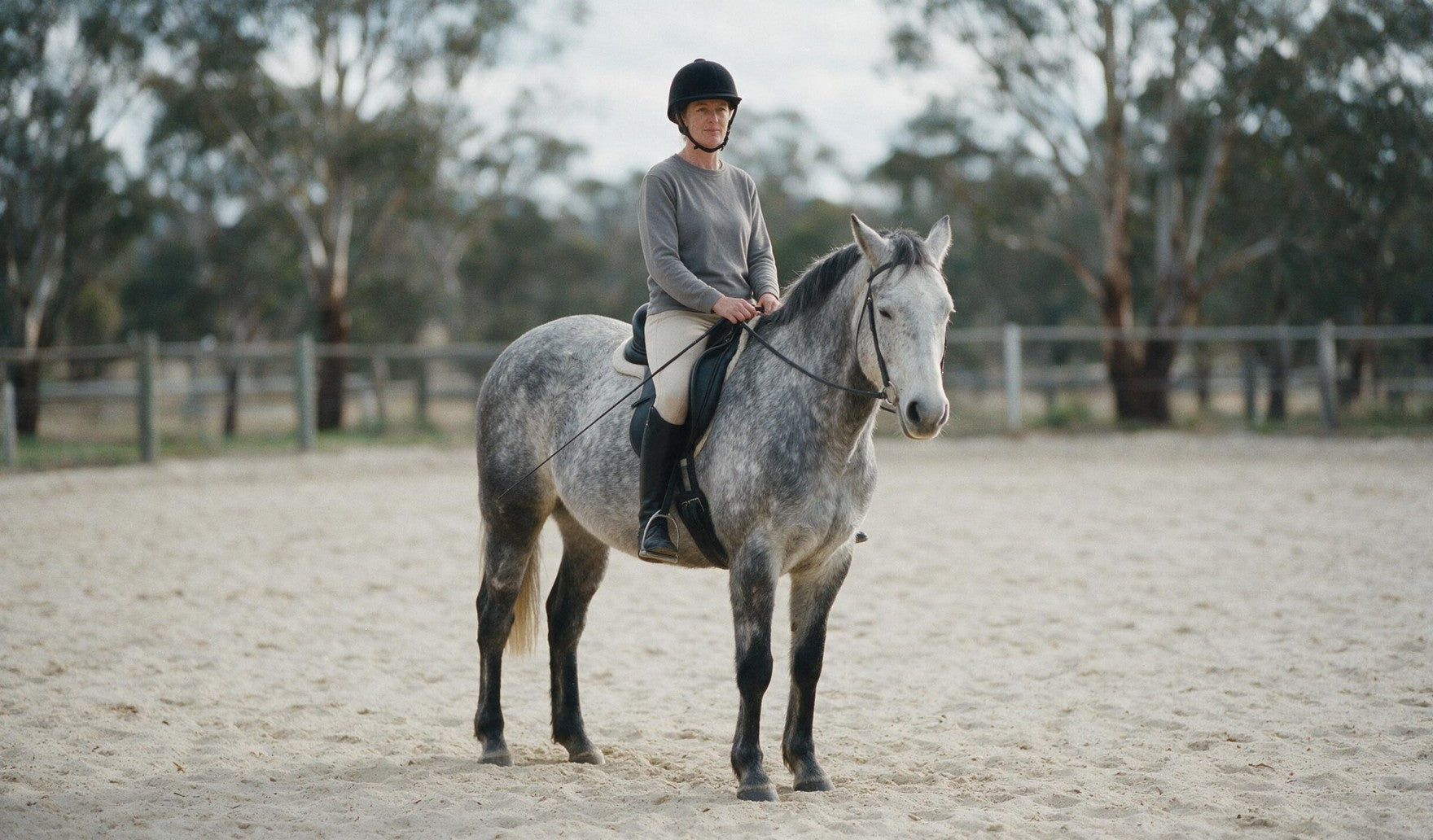
A riding crop and a dressage whip are not the same tool, and the difference that matters is not simply their length—it is what each one allows your hand to do. A crop is short and relatively stiff and is generally used behind the leg or, in some disciplines, against the shoulder. Using it behind the leg usually requires you to move one hand away from its normal rein position. A dressage whip is long and flexible, allowing you to reach just behind your leg without significantly changing your hand position. That distinction usually determines which one belongs in your hand, and it is the mix-up we untangle most often at the counter.
Before any of it, one thing worth saying plainly. A whip is an aid, not a correction. If you are reaching for one because your horse is not going forward, the honest first questions are about saddle fit, teeth, feet, soreness, fitness and the clarity of your leg aid. A whip may help you make an aid clearer. It will not fix a horse that is uncomfortable or confused, and we would rather tell you that than sell you one.
What is a riding crop?
A riding crop is short, commonly around 60 to 70 centimetres long, with a relatively stiff shaft and a flat leather or synthetic keeper at the end. The keeper spreads the contact over a wider area, allowing the rider to reinforce an aid without relying on force.
Because it is short, a crop is used behind your leg, which generally means moving a hand off the rein to do it. Its shorter length also makes it more practical over a fence, where a long whip can get in the way, which is why the crop is the jumping and general-riding tool. It is also the whip most riding schools ask beginners to carry, if they ask for one at all.

What is a dressage whip?
A dressage whip is long, thin and flexible, with a short lash at the tip rather than a keeper. It is designed so you can reach your horse's flank, just behind your leg, without moving your rein hand.
That is the whole point of it. In dressage the contact and the rider's position are being judged, and a hand that leaves the rein to use a crop disturbs both. The flexible shaft also means a very small movement of the fingers produces a light touch at the tip, so the aid can be quiet and precise rather than a swing.
The trade-off is that a dressage whip is not much use over a fence, and it is easy to catch on things when the length is not what you are used to.
Riding crop or dressage whip: which do you need?
Riding crop or dressage whip: which do you need?

Match the whip to what you do most, not to what looks smart in the tack room.
- Flatwork, schooling and dressage. A dressage whip, because you keep both hands on the rein.
- Jumping, cross-country and general riding. A crop, because it is short enough to stay out of the way and a hand often comes off the rein anyway.
- Both, regularly. Most riders who do both end up owning one of each. They are inexpensive enough that it is a sensible thing to do, and swapping is quicker than compromising.
- Pony Club and lessons. Ask your instructor or club what they expect you to carry. Some ask for a short crop, some ask for nothing at all.
What about lunge whips and stock whips?
These are a different job again, and they are not ridden whips.
A lunge whip is long, often 160 to 200 centimetres, with a separate lash, and it is used from the ground to direct a horse working on a circle around you. Its length is what lets you stay at the centre of the circle and still reach the horse's shoulder or quarters with the lash on the ground, or simply with the movement. It has no place in the saddle.
A stock whip is an Australian working whip with a plaited thong and a cracker, used mustering and in stock work, and it is a skill of its own. Ours come in redhide and synthetic, and the cracker is a consumable that gets replaced.
How long should a dressage whip be?

Long enough to reach your horse's flank from a still hand, and no longer. In practice that depends on your arm, your horse's build and the saddle you sit in, which is why we would rather stand you next to your horse than give you a number from a chart.
There is a second consideration if you compete: the rules depend on your discipline, level and whether you are riding a horse or pony.
Under the 2026 Equestrian Australia dressage rules, riders may carry a whip up to 120 centimetres long on a horse and up to 100 centimetres on a pony, including the lash. One whip may be carried in the exercise and warm-up areas and in tests up to and including Advanced level.
Different restrictions apply to FEI-level tests at State and Australian Championships, as well as certain Young Horse competitions. International FEI and CDI competitions may also operate under different requirements.
Equestrian Australia publishes a Dressage Equipment Annex that is updated periodically, currently Version 23, effective 1 January 2026. Before buying a whip for competition, check the current rules for your discipline and level rather than relying on what applied the previous season.
If you are riding at home and not competing, the practical consideration is that the whip should reach just behind your leg without requiring you to move your hand out of position.
What to look for in a whip
- Balance. Hold it as you would ride with it. A good whip feels like an extension of your hand rather than a weight on the end of it. This is genuinely the thing that separates a whip you keep from one you leave in the float.
- The handle. Rubber, leather-look or a moulded grip. Sweat and rain both matter here, and a grip that works in a Melbourne winter is worth more than one that looks smart.
- The keeper or lash. On a crop, check the keeper is well stitched or moulded where it meets the shaft, because that join is what wears. On a dressage whip, the lash is a wearing part and a whip with a replaceable one lasts longer.
- Length, checked against your horse. See above.
- The wrist loop. Some riders like one, many instructors would rather you did not use one, because a whip you cannot drop is a whip you cannot let go of in a fall.
Our whip range runs from a simple braided crop through to covered dressage whips, lunge whips and plaited stock whips.
Using a whip well
Two things are worth saying, because they matter more than which whip you buy.
Every discipline regulates how a whip may be used as well as how long it may be, and those rules are enforced rather than treated as a technicality. Equestrian Australia also alerts competitors that cruel application of spurs, whips or bits is illegal in some Australian states and territories. Check the current rules for your discipline and level.
More practically, a whip used badly teaches a horse very little. It works as a back-up to a leg aid that the horse already understands, applied once, immediately, and then put away when the horse responds. A whip used repeatedly is a sign that something else needs looking at, and that is a conversation for your instructor or your vet rather than for us.
Quick answers
What is the difference between a riding crop and a whip?
A crop is short and stiff and is generally used behind the leg, which usually means moving a rein hand. A dressage whip is long and flexible, so it lets you reinforce the leg aid with minimal change to the rein hand.
Can I use a dressage whip for jumping?
It is not the most practical choice. Its length can get in the way over a fence, whereas a short crop is easier to carry while maintaining your balance and rein contact.
How long should my dressage whip be?
Long enough to reach the flank from a still hand. If you compete, check the current rules for your discipline and level, including whether a whip may be carried in the arena at all, because that differs by discipline and it changes.
Do beginners need a whip?
Usually not at first. Ask your riding school, because many prefer a new rider to have both hands and full attention on the rein and the leg before adding anything else.
Come and hold a few in Flemington, or ring us on (03) 9376 5444 and describe what you ride and how you ride it. We will tell you which one suits, and just as readily when the simplest one on the wall is the right answer.


![Academy All Purpose Saddle Kit Black [:17.0"]](http://www.ascotsaddlery.com.au/cdn/shop/files/20125646_1.jpg?v=1746406077&width=600)


