

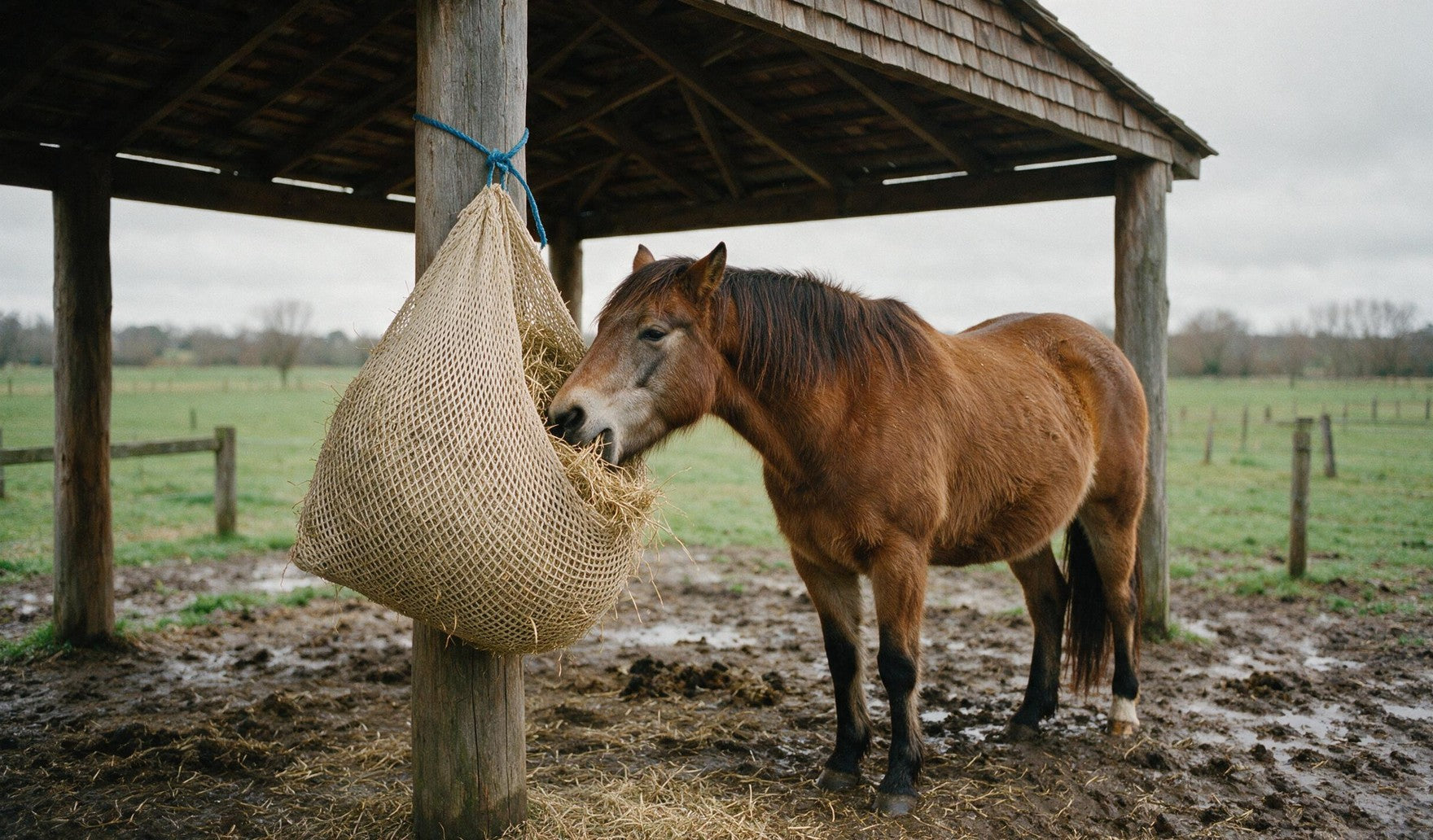
A slow feeder does one thing: it makes your horse take longer to eat the same amount of forage. Nothing more, and it is worth being clear about that up front, because slow feeders get sold as an answer to weight, boredom and behaviour when what they actually change is the rate of eating.
That said, the rate of eating matters. A horse in a paddock grazes for most of the day in small amounts, and a horse given a biscuit of hay on the ground can finish it in well under an hour and then stand with nothing to do for the rest of the night. Slowing that down is closer to how a horse is built to eat, and it is why so many owners end up with a net or a bag in the float, the stable and the paddock.
Here is how the options differ and which suits which horse, from a shop that has sold all of them for years.
Hay net, hay bag or slow feed ball?

Hay nets are the traditional option and still the most common. A conventional net has large openings and slows a horse only a little. A slow feed net uses much smaller openings, which is what does the work. They are light, they pack flat and they are the cheapest way to start. Round bale nets are a different product again, sized to go over a whole bale in the paddock.
Hay bags are a closed fabric or PVC bag with a restricted opening, and they hold their shape as they empty. They are tidier than a net, they keep hay off the ground and out of the mud, and they generally suit a stable, a float or a tie-up area better than a net does. Our slow-release and slow-feeder bags run from light fabric versions up to the heavier PVC and canvas ones.
Slow feed balls are a hard ball with a hole that releases pellets or chaff as the horse rolls it. They are enrichment rather than a forage system. For a stabled horse on box rest, or one that gets bored and destructive, a ball gives them a job. They do not replace hay.
Most owners with a horse in regular work end up with a net or bag for forage and, if the horse is stabled a lot, a ball as well.
Hole size is the setting that matters

The opening size is what determines how much slower your horse eats, and getting it wrong in either direction causes a problem.
There is decent research on this. A University of Minnesota study fed adult horses the same meal from the stall floor and from nets with 15.2cm, 4.4cm and 3.2cm openings. Off the floor the meal was gone in about 3.2 hours. From the small-holed net it took about 6.5 hours, roughly double. Fed twice a day, a small or medium net puts a stabled horse at something like 10 to 13 hours of foraging, which is much closer to how a horse in a paddock spends its day. The same work found horses generally need four or five feeds to get the hang of a net, so judge it after a week rather than on the first night.
Too large and nothing changes, which is the usual outcome with a standard hay net. Too small and some horses give up, walk away, and eat less than they should. Others get frustrated and start pulling at the net rather than eating from it, which wears the net out and can wear teeth over time.
Start with a moderate opening and watch what your horse actually does before going smaller. A good-doer who inhales hay and a poor-doer who picks at it need different settings, and so do a young horse and an older horse whose teeth are not what they were. If your horse is losing condition after you introduce a slow feeder, that is a sign the setting is wrong, and it deserves a proper look at feed, teeth and health with your vet rather than a smaller net.
Paddock or stable?
Where the horse lives should decide what you buy.
In a stable or a float, a bag is usually easier. It holds hay off the floor, it does not swing as much, and it empties tidily. Follow the manufacturer's instructions on hanging, and position it so your horse cannot get caught up in it as it empties. Lower is generally kinder on the neck and keeps hay seed out of the eyes, but the right height varies with the horse and the feeder.
In a paddock, nets and round bale nets do the work, but hanging is the thing to get right. A net hung too low is the accident we hear about most, because as it empties it drops, and a shod or striking hoof can go through it. Hang it high enough that it is still clear of the ground when it is empty, tie it with a quick-release knot, and check it whenever you check the horse.
Barefoot horses on soft ground can often be fed from a ground-level slow feeder box or a net inside a tub, which suits a horse's natural grazing posture better. Shod horses are the ones where hanging height matters most.
Feeding more than one horse

A slow feeder concentrates a resource, which changes how horses behave around it. Two horses and one net is a recipe for the quiet one going short.
Put out more feeding points than you have horses, spread far enough apart that one moved off a net can reach another without walking past the boss. It means a lower-ranking horse is never pushed away from forage altogether, or left eating in a hurry. In practice this is where owners underestimate what they need, and where a cheap extra net earns its money.
Cleaning, wear and how long they last
Hay dust and saliva build up in a net, and a net stored damp goes mouldy the same way a rug does. Shake nets out regularly, wash them occasionally and dry them completely before they go away.
Nets wear at the point where they are tied and where the horse pulls hardest, so check the top rope and the seams. Bags wear at the opening. Neither is expensive to replace, and a worn net that a hoof can go through is not worth keeping for sentiment.
PVC and canvas bags outlast fabric ones considerably and are worth the difference if your horse is hard on gear or your feeder lives outside.
Spring grass, and where a slow feeder does and does not help
In Victoria the pasture flush arrives from about now, and it is the season when owners start asking us about slow feeders for the first time. A slow feeder is useful in that conversation, because it lets you spread a measured amount of suitable forage over a longer period rather than a horse standing in front of an empty net for hours. What goes in the net is a separate decision, and a slow feeder does nothing to change it.
What it does not do is manage grass intake in a paddock, because it has no effect on what the horse eats off the ground. Restricting pasture is a separate job involving grazing management, and how you balance hard feed alongside it matters too. Horses at risk of laminitis or with a metabolic condition need a plan made with your vet, not a piece of equipment. If your horse has had laminitis before, is overweight, or you have any concern about their feet in spring, ring your vet before you change anything about how they are fed.
We will happily talk through nets and bags. We will not tell you a slow feeder prevents laminitis, because it does not.
Quick answers
Do slow feeders actually work? They slow the rate a horse eats forage, which is what they are for. Whether that helps depends on why you wanted one.
What size holes should a slow feed net have? Start moderate, watch your horse for a week, then adjust. Good-doers usually need smaller openings than poor-doers, and older horses with worn teeth often need larger.
How high should I hang a hay net? High enough that it is still clear of the ground when it is empty, tied with a quick-release knot. A net that drops as it empties is how hooves get caught.
Hay net or hay bag? Net for the paddock and for round bales, bag for the stable, the float and the tie-up rail. Plenty of owners have both.
Can a slow feeder help a horse who bolts their feed? For hay, yes, that is the point. For hard feed, a slow feed bowl or ball is the equivalent, but a horse bolting feed is also worth mentioning to your vet.
Our feed bins and hay bags range covers slow feed nets, round bale nets, slow-release bags and feed balls. If you are not sure which suits your set-up, ring us on (03) 9376 5444 and describe the paddock, the horse and how they are fed. We will tell you what will work, and just as readily when the simplest net on the wall is the right answer.


