

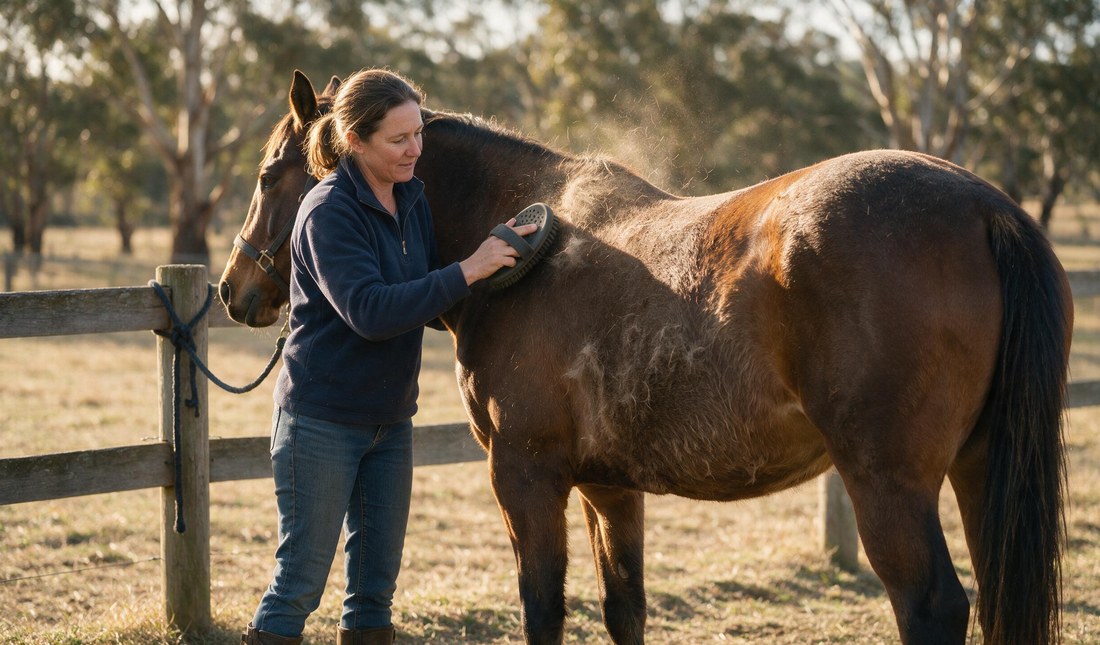
When your horse is dropping coat in handfuls and the brushes cannot keep up, a curry comb or shedding block will do most of the work. Use it firmly in a circular motion before reaching for a body brush. The rest of the kit tidies up afterwards. A basic, effective grooming kit for spring includes a rubber or plastic curry comb, a shedding block, a stiff dandy brush, a soft body brush, a mane and tail comb and a hoof pick.
The timing can be surprising, because spring shedding is not primarily about the weather warming up.
Why do horses shed their coats in spring?

Coat change in horses is driven by day length rather than temperature. Light entering the eye regulates melatonin production, and this seasonal signal, the lengthening days after the winter solstice, tells the coat to let go. Research on hair growth in horses and ponies has shown that extending the photoperiod drives coat change, while warmth alone has a far smaller effect.
This is why horses in Victoria can start dropping coat while the mornings are still cold, and why a run of warm August days does not reliably bring the coat out. Coat change also follows the daylight shift by several weeks, so the horse is responding to a signal received some time earlier.
There are two practical consequences. First, the process cannot be rushed, and heavier rugging will not bring the coat out faster. Second, if your horse is not shedding when every other horse in the paddock has, it deserves closer attention rather than more vigorous brushing.
What grooming tools do I need for shedding season?

An effective kit does not need to be expensive. A few well-chosen tools, used in the right order, are all you need.
- Curry comb. This is the workhorse of the kit. A rubber or plastic curry comb, used in firm circular motions on the fleshy parts of the body, lifts loose hair, scurf and mud to the coat's surface. Most horses enjoy the sensation, which matters because a horse that likes being groomed is easier to handle elsewhere. Keep it away from bony areas and legs.
- Shedding block or grooming block. This soft block pulls loose hair away in sheets. Many people are pleasantly surprised by how effective it is the first time they use one, and shedding blocks cost very little.
- Dandy brush. Its stiff bristles, used with short flicking strokes, sweep away lifted hair and dried mud. Choose a gentler tool for a sensitive-skinned horse's face or clipped areas.
- Body brush. Soft bristles collect the fine dust left by the dandy brush and add shine to the coat. Hold a metal curry comb in your other hand to clean the bristles every few strokes, and use the body brush at the skin's surface rather than for removing mud.
- Mane and tail comb. This takes care of the areas a body brush will not sort out.
- Hoof pick. An essential for every day, during shedding season and throughout the year.
The order matters more than the brand: begin with the curry comb or block to lift the coat, use the dandy brush to sweep it away, then finish with the body brush.
How do you get a winter coat out faster?

The natural timing cannot be hurried very much. What you can do is support the process and keep your horse comfortable while the coat comes out.
Grooming more often and for longer is more helpful than grooming harder. Ten minutes each day achieves more than half an hour on a Saturday. Work in the direction of the hair with the brushes and use circles with the curry comb. For a horse in light work, a warm day and a light sweat can loosen the coat noticeably, making grooming straight after exercise more productive than grooming a cold, dry horse.
Some owners choose to clip rather than wait. It is a reasonable option for a horse in real work that is sweating up and taking hours to dry, and our clippers and blades cover that. A paddock horse does not need clipping solely because its coat looks scruffy in September.
Take a gentle approach on legs, faces and clipped areas. Skin over bone has very little padding, so a tool that feels pleasant across a shoulder may be uncomfortable over a cannon bone.
When is shedding a reason to call the vet?

This is important to understand, which is why knowing the mechanism behind horse shedding is more useful than adding more brushes to the grooming kit.
A horse that fails to shed, retains a long curly coat into summer, or sheds very patchily may be showing signs of pituitary pars intermedia dysfunction, commonly called PPID or equine Cushing's disease. Delayed or incomplete shedding is one of the recognised signs, particularly in older horses. It cannot be diagnosed from an article or managed through grooming, and it needs prompt attention because horses with PPID carry a higher laminitis risk. If your horse's coat is not behaving like the others in the paddock, speak with your vet.
Other signs that deserve a vet's opinion include bald patches, scurfy or flaky skin that does not improve, sore or scabby areas, and any broken skin. More vigorous grooming will make a sore horse uncomfortable and may teach it to dread being caught.
Coat quality is not only a matter of grooming. Growing and shedding a coat draws on the horse's overall condition, so a dull, slow-shedding or poor coat may reflect feed, health or parasite burden rather than brushing frequency. Your vet or an equine nutritionist can assess the whole diet and advise appropriately, instead of relying on a supplement selected from the shelf.
Grooming is also one of the best routine health checks available to owners. Putting hands and eyes over the whole horse every day helps you notice heat in a leg, a small cut, a girth-area rub or a change in condition while each is still a small problem.
Does spring shedding mean my horse needs a different rug?

Often, it means using fewer rugs rather than different ones. As the coat comes out and the days become warmer, a horse wearing a heavy winter rug can overheat well before you get home. Step down the rug weights through August and September instead of waiting until a hot day forces the decision. We explain how to assess this in our guide to when to rug a horse, and once the rugs come off, washing and storing them properly will determine whether they are usable next May.
Quick answers
Why is my horse shedding so much?
Day length is increasing. Coat change is triggered by light rather than temperature, and spring is the season when the winter coat is released.
What is the best tool for shedding a horse?
A curry comb or a shedding block, used firmly in circular motions before following with any brush.
How often should I groom a shedding horse?
Daily if possible, for ten minutes at a time, rather than relying on one long session each week.
Should I clip instead of waiting for the coat to drop?
Consider clipping if the horse is in work and sweating up. A paddock horse does not need clipping solely to look tidy.
My horse is not shedding at all. Is that a problem?
It can be. Delayed or patchy shedding, especially in an older horse, is a recognised sign of PPID and warrants a call to your vet.
Where to start
Our horse grooming range covers everything you need, and the most useful part of a spring kit is inexpensive. A Slick N Easy grooming block or a hair shedding block handles the heavy lifting, an Ezy Groomer suits anyone who prefers a tool with a handle, and a fine tooth curry comb will still be useful in your kit in ten years.
If you are putting together your first kit and would like help choosing what you need, ring us on (03) 9376 5444 or visit us in Flemington and we will talk you through it. We have been outfitting Melbourne horse owners since 1977, and everyone is welcome, whatever their level of experience.
Sources
- Osthaus, B. et al., The effects of extended photoperiod and warmth on hair growth in ponies and horses at different times of year, PLOS ONE / PMC. https://www.ncbi.nlm.nih.gov/pmc/articles/PMC6959597/
- Kentucky Equine Research, Hairy Horses: Notes on Seasonal Coat Growth. https://www.ker.com/equinews/hairy-horses-notes-seasonal-coat-growth/
- Agriculture Victoria, Basic horse care. https://agriculture.vic.gov.au/livestock-and-animals/horses/basic-horse-care


