

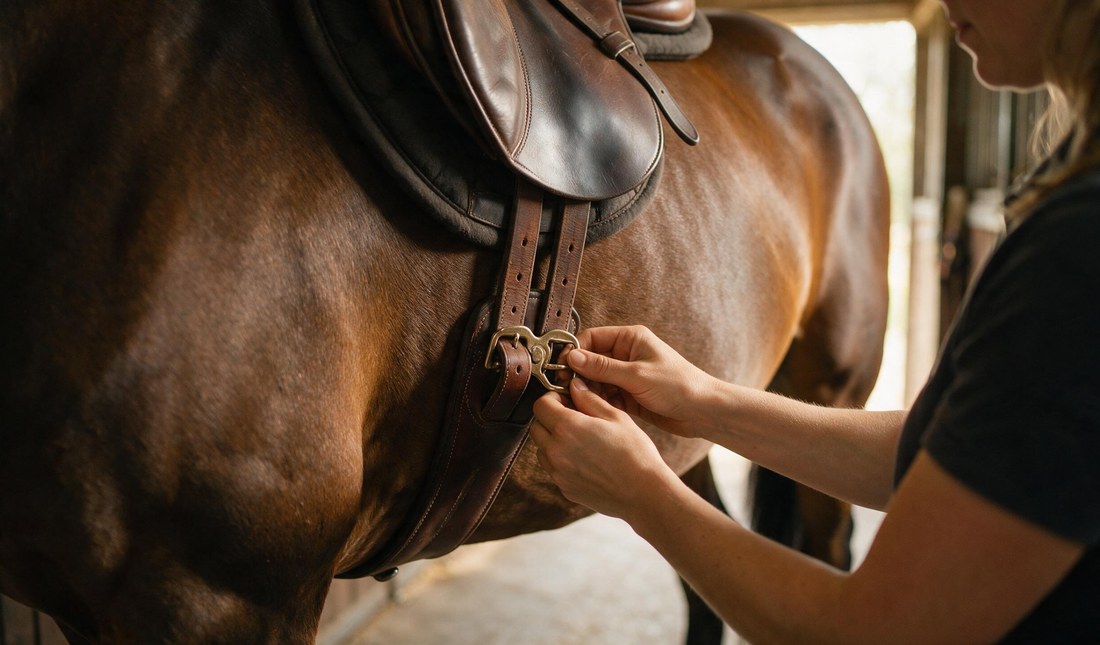

A girth has one important job: to hold the saddle in place without interfering with the horse underneath it. Choose it by considering three things in this order: the type of saddle you are using, the shape of your horse behind the elbow, and how your particular horse responds to pressure there. Price and colour come well after those.
The girth is also the single most common piece of gear suspected when something is wrong, although quite often it is not the cause. We will come to that, because understanding the cause matters more than the shopping.
What does a girth do?
It runs under the barrel and attaches to the billet straps on each side of the saddle, holding the saddle in position through the girth groove, the natural dip behind the elbow where the horse's conformation encourages a strap to sit.
That groove is the key to most fit problems. It sits in a slightly different place on every horse, and a girth will naturally try to migrate into it. If your saddle is sitting where it should but the girth wants to slide forward into the elbow, or backwards towards the flank, the girth shape is working against your horse's anatomy. The result will feel like a saddle that will not stay put.
Behind the girth area sit the pectoral muscles, the ribs and, further in, the stomach. Pressure applied here matters, which is why girth design has received a fair amount of research attention.
What types of horse girth are there?

Long girths attach to standard billets on dressage and general purpose saddles, where the buckles sit under the flap. Short girths are used with dressage saddles that have long billets, allowing the buckles to sit below the flap and away from the rider's leg. This choice is fundamental to a good fit, so check your saddle's billet length first.
From there, the most useful distinctions are shape and lining:
- Straight girths have a straightforward design and suit many horses very well.
- Atherstone girths have a shaped centre and narrower sections behind the elbows to provide additional room as the forelegs move. They are worth considering for horses that rub or need more elbow clearance.
- Anatomical girths have become our most popular style. They are shaped around the horse’s anatomy to provide greater clearance behind the elbows while distributing pressure across a broader central area. Different anatomical designs suit different conformations, including horses with a forward girth groove or limited space behind the elbow. The shape still needs to match the individual horse—a more sculpted girth is not automatically a better fit.
- Anti-gall girths use a soft, forgiving material to reduce rubbing, making them popular for horses in regular work and those with sensitive skin.
- Wool-lined girths provide soft cushioning and can be gentle on the skin, although they need regular cleaning to remain that way.
- Pressure-relief and contoured girths are designed to redistribute pressure away from areas where measurements may be highest beneath a conventional girth.
- Girths with elastic ends allow some give as the horse’s ribcage expands. Elastic at both ends can help distribute tension more evenly. With single-sided elastic, particular care is needed to tighten the girth evenly and avoid drawing the saddle towards one side. Elastic can also make a girth easier to overtighten without noticing, so always tighten it gradually and in stages.
There is research behind that last point. Girth pressure measurement studies have found that peak pressures under conventional girths can be high, and that an alternative girth design both reduced those peaks and was associated with increased forelimb protraction and flexion in the swing phase. In practical terms, the shape of the girth can change how the horse moves in front. This does not mean an expensive girth will resolve every problem, but it does make shape an important consideration rather than treating a girth as a generic strap.
Materials range from leather, which lasts and softens with use but benefits from regular care, through to synthetic and neoprene, which are easy to wash and suit horses in frequent work.
One note on terminology. If you ride western, the same job is performed by a cinch, which is sized and buckled differently and is not interchangeable with an English girth. We stock English girths rather than western cinches, so for riders coming from a western background, that is the distinction to look for.
Girth sleeves and covers are also worth considering separately. A fleece or sheepskin sleeve slides over the girth to soften it for a horse that rubs or has thin skin, and our girths range carries both alongside the girths themselves. It helps to be clear about the role of a sleeve: it softens a girth that fits. It cannot correct one that is the wrong length or shape for the horse.

How should a girth fit?

Start with length. The buckles should sit somewhere around the middle of the billet range on both sides, leaving room to adjust up or down as your horse's condition changes through the season. A girth fastened on the last hole on both sides is too short, while one fastened on the top holes is too long and will bring the buckles up under the rider's leg.
The easiest way to determine your size is to measure a girth that already fits that horse and saddle, from the pin of one buckle to the pin of the buckle at the other end, and match it. Alternatively, ring us with details of your horse and saddle type and we will work it out with you. We do not publish a sizing chart because girth length depends on the horse, the saddle's billet length and the position of that horse's girth groove, all of which need to be considered.
Next, look at position. The girth should sit a hand's width or so behind the elbow, in the girth groove, without pinching any skin at the elbow. After girthing, pull each foreleg forward to smooth the skin underneath. It takes five seconds and helps prevent many rubs.
Next, check the tension, which needs to be secure without being over-tightened or dangerously loose. Fasten it gradually in stages rather than all at once, walk the horse forward a few steps, and check it again. Research on girth tension has recorded very high peak forces during the tightening process compared with the tension at which the girth eventually settles. This supports tightening slowly and in stages rather than pulling it up in one motion.

Why does my horse hate being girthed up?

This is the question we are asked most often about girths, and it is important to recognise that the girth itself is often not the underlying problem.
In a retrospective veterinary study of 37 horses referred specifically for girthiness, gastric ulceration was the most common finding among those examined by gastroscopy, and owners reported that the girthiness resolved with treatment. The same study identified orthopaedic problems in a further group, including vertebral osteoarthritis and lameness. Saddle fit and a full lameness examination were recommended as part of the workup in every case. As these horses had already been referred for the problem, the findings indicate what is worth investigating rather than how common each cause is across all horses.
Before choosing a softer girth, it is worth working through this list:
- Pain in the stomach. Girthiness can occur in horses with gastric ulceration. This requires veterinary attention, not a purchase.
- Saddle fit. A saddle that pinches or bridges can make a horse resent the moment the girth is fastened, because that is when the saddle is pulled down onto its back.
- Soreness elsewhere. Problems affecting the back, neck and limbs can all present as an objection to girthing.
- Technique. Gradual tightening is important, as fastening the girth quickly and firmly in one motion can teach a horse to brace.
- Finally, consider the girth itself. Look for rubbing, skin pinched at the elbow, a shape that does not suit that horse's girth groove, or a lining that has become hardened and dirty.
A different girth may certainly help a horse that is uncomfortable. It cannot resolve ulcers, so it is important to identify the cause before making a purchase. If girthiness has developed gradually in a horse that was previously comfortable, treat it as a health question first.
Does my saddle fit need checking too?
If the girth will not stay put, or your horse has begun objecting, then yes. Saddle position and girth behaviour are linked, and a saddle sitting too far forward will draw the girth into the elbow regardless of which girth you choose.
Horses also change shape throughout the year, particularly when coming out of a winter spell, so a saddle that fitted in autumn may sit differently now. Our guide to saddle fitting explains what a fitting involves and the signs worth watching for.
Quick answers
What size girth do I need?
Choose one that leaves the buckles around the middle of the billets on both sides. Sizing depends on your horse and your saddle's billet length, so measure an existing girth that fits or ask us for guidance. A quick hint if you have a long girth you can deduct 50cm to give you the approximate girth size for your short girth
What is the difference between a long and short girth?
Long girths suit standard billets, where the buckles sit under the flap. Short girths suit dressage saddles with long billets, allowing the buckles to sit below the rider's leg.
How tight should a horse's girth be?
It should be firm enough that the saddle cannot slip, tightened gradually in stages and checked again after walking forward. Avoid pulling it up in one motion.
What is an anti-gall girth?
It is made from a soft, forgiving material to reduce rubbing and is often chosen for horses in regular work or those with sensitive skin.
Is a cinch the same as a girth?
It performs the same job on a western saddle, but cinches and English girths are sized and buckled differently and are not interchangeable.
Why is my horse girthy?
Girthiness can have several causes, including gastric ulcers, musculoskeletal pain, saddle fit, girth fit and previous negative experiences. New or persistent girthiness should be discussed with your vet before changing girths.
Where to start
Our horse girths range includes straight, Atherstone, anatomical, anti-gall, wool-lined and pressure-relief designs across dressage and general purpose lengths. Anatomical girths have become our most popular style, but the best choice still depends on the position of your horse’s girth groove, the space behind the elbow and the billets on your saddle. . The Equiprene Atherstone anti-gall girth is a sound general purpose starting point, the Equiprene wool lined dressage girth suits horses that mark up easily, and the Equiprene Pressure Eze dressage girth is the shaped option for horses that are tight through the elbow.
If you are unsure whether the girth or the saddle is causing the problem, ring us on (03) 9376 5444. We have been fitting saddles in Melbourne since 1977, and we will gladly help you understand what is going on and choose a girth only if it is likely to help.
Sources
- Millares-Ramirez, E. and Le Jeune, S., Girthiness: Retrospective Study of 37 Horses (2004-2016), Journal of Equine Veterinary Science. https://www.sciencedirect.com/science/article/abs/pii/S0737080619303223
- Murray, R. et al., Girth pressure measurements reveal high peak pressures that can be avoided using an alternative girth design, The Veterinary Journal. https://www.sciencedirect.com/science/article/abs/pii/S1090023313003651
- The Effect of Girth Design and Girth Tension on Saddle-Horse Pressures and Forelimb Stride Kinematics in Rising Trot, PMC. https://www.ncbi.nlm.nih.gov/pmc/articles/PMC12427339/


