

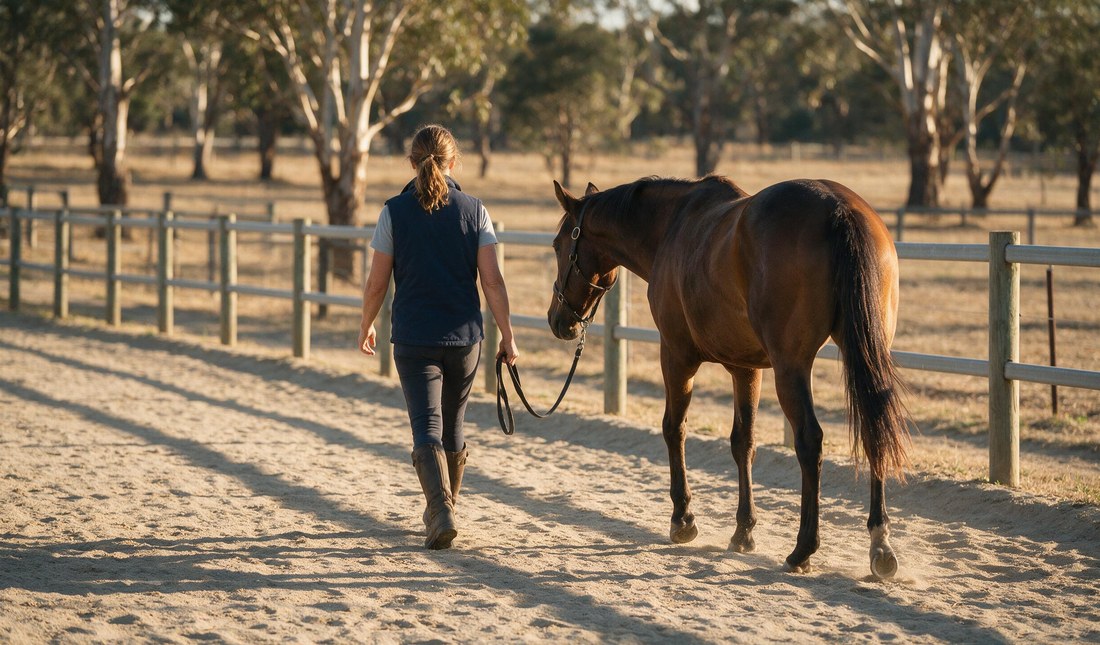
After a long spell, think in weeks of walking rather than days. The most useful thing to understand about bringing a horse back into work is that the different tissues in your horse regain condition at different speeds.
Muscle responds quickly and can make a horse feel ready. Tendons, ligaments, bone and cartilage adapt much more slowly, and these structures can be injured when a horse is asked to do more than its frame is ready for. A horse can feel fit weeks before it is.
Spring is when many of us in Victoria begin this process again, so it is worth taking the time to do it properly.
What happens to a horse over a spell?

Fitness is not one thing that simply switches off. Cardiovascular fitness begins to decline during time away from work. Muscle mass and topline can reduce too, which is the change you are most likely to see. Less visible are the changes occurring in the supporting structures.
Reviews of how bone, articular cartilage and tendon respond to exercise show that these tissues remodel in response to loading, but they do so at different rates and on a much longer timescale than muscle. Bone responds to the loads placed on it over weeks and months. Tendons in mature horses have a limited capacity to adapt and are slow to repair.
After several months out of work, a substantial amount of the horse’s previous conditioning may have been lost. It needs to be rebuilt progressively rather than treated as something that only requires a quick top-up.
In practical terms, your horse’s enthusiasm is not a fitness test. A horse that feels wonderful on day four may have recovered its energy, but its tendons, ligaments and bones still need time.
What should I check before I start?

There are five things to check, beginning with one that can easily be overlooked.
- Saddle fit. A horse coming back after a spell rarely has exactly the same back it went out with. Topline can reduce over months away from work, the shape through the wither and shoulder may change, and a saddle that fitted in autumn can sit quite differently now. Its fit may then change again as the horse muscles up. Check the fit before you start and again once the horse is properly back in work.
- Teeth. Make sure your horse’s dental care is up to date before returning to ridden work. Head-tossing, resistance to the bit or difficulty eating should be investigated rather than dismissed as freshness or a schooling problem.
- Feet. Arrange the farrier before you begin. Feet that have been growing through a wet winter on soft ground may be meeting firmer spring ground, so hoof balance and shoeing or trimming requirements should be checked.
- Condition. Bring a horse that has wintered well back gradually. A horse that has wintered poorly also needs a gradual return, along with veterinary advice about why it has lost condition.
- Vaccinations, parasite control and general health. Check that vaccinations are current and that parasite management, including faecal egg counts where appropriate, is up to date. These routine details are an important part of preparing to begin.
If your horse came out of work because of an injury rather than for a seasonal spell, the general plan below is not appropriate. Rehabilitation following a tendon, ligament, bone or joint injury requires a specific programme set by your vet and should not be improvised from a general article.
How long should it take to bring a horse back into work?

Allow plenty of time, as there is no schedule that suits every horse. For a healthy horse coming back after a straightforward spell, most conditioning approaches move through four phases, with each one beginning only once the horse is coping comfortably with the previous phase:
- Phase one: build a walking base. This can be in hand, long-reining or under saddle. Use straight lines and even ground, gradually lengthening the sessions. Walking is valuable conditioning because it introduces controlled loading while allowing tendons, ligaments and bones to begin adapting. For a horse returning after a long spell, this foundational phase should not be rushed.
- Phase two: introduce trot gradually. Begin with short periods of trot and build them slowly, still working mostly in straight lines on good surfaces. Gentle hill work can be introduced if you have safe, suitable ground.
- Phase three: add controlled canter. Begin shaping the work towards what the horse will eventually be asked to do. Increase one element at a time—duration, speed, difficulty or frequency—while keeping the others steady.
-
Phase four: introduce discipline-specific conditioning. Lateral work, poles, jumping, collection and faster work can be introduced progressively once the horse has established an adequate base.
Allow recovery days between more demanding sessions. Your horse should finish with something left in the tank rather than being worked to exhaustion.
How long each phase takes depends on how long your horse has been out, its age, previous fitness, health history, activity during the spell and what you are building towards.
Older horses often benefit from a longer, gentler return, particularly if they have lost topline, have reduced mobility or have arthritic changes that a sudden increase in work may reveal. A horse that has had a few weeks off is a very different proposition from one that has been out since autumn.
As a general principle, a long spell should be followed by a long, progressive return. Treat that as a reason for patience rather than a fixed timetable. For a programme with specific weeks and workloads attached to it, speak with your vet or an instructor who can assess the horse in person.
The surface matters as much as the schedule. During the early weeks, look for level, even and consistent going, whether that is a well-maintained arena or a firm sand track. Deep, boggy, slippery or uneven ground asks much more of the structures you are trying to protect.
What should I watch for along the way?

Reduce the work if you notice:
New or persistent filling in a leg, particularly if it remains the following morning
Heat in a tendon or joint
A shortened or uneven stride
Persistent stiffness
Reluctance to go forward when the horse was previously willing
A change in behaviour, such as becoming unusually sour or resistant
Tiredness that continues well beyond the session
A loss of appetite or general dullness
Mild tiredness as the horse begins rebuilding fitness is to be expected, but stiffness, shortened steps or reluctance to move freely should not automatically be dismissed as unfitness.
A horse that is lame, has heat or filling in a limb, shows persistent stiffness or is not improving needs veterinary assessment. Do not work through heat in a tendon or unexplained lameness.
Feel your horse’s legs every day, before and after work, so you become familiar with what is normal for that horse. Making this a daily habit helps you recognise subtle changes early.
What gear helps?

You do not need much equipment during this stage. Time and steady conditioning do most of the work.
Lungeing can be useful when it is done well because it allows you to observe the horse’s movement, but it should not automatically be considered a gentler alternative to ridden work. Circles load the limbs unevenly, and a small circle at trot asks considerably more of a horse returning to work than walking in a straight line.
Keep circles large, sessions short and the time even on both reins. Our lungeing and schooling range includes cavessons and side reins, and a correctly fitted padded lunge cavesson provides clear control without attaching the lunge line directly to one bit ring. If you are new to lungeing, side reins are best introduced under instruction rather than from a diagram.
Long-reining is worth learning for similar reasons, with the added benefit of allowing the horse to work in straight lines.
Quiet hacking, where you have safe ground and suitable company, is one of the best options during the early phases. It offers straight lines, varied terrain, a horse thinking about something other than a circle and a rider who can feel changes in the stride as they happen.
Brushing boots can be a sensible choice for a horse that is unfit and slightly uncoordinated, as a tiring horse may be more likely to strike into itself. A straightforward pair such as the Woof Double Velcro Brushing Boots is sufficient.
Fit exercise boots clean and dry, remove them promptly after work and check underneath for heat, sweat or rubbing. Exercise boots should not be left on for extended periods unless they are specifically designed for that purpose.
Beyond that, a diary, the habit of feeling your horse’s legs every day and plenty of patience are the most useful things to have.
Quick answers
How long does it take to get a horse fit again?
It depends on how long the horse was out, its age, previous fitness, health history and the work you are preparing it for. A long spell generally requires a long, patient return. Your vet or instructor can develop a programme for your particular horse.
How long should I walk before trotting?
For a horse returning after a long spell, think in weeks of progressive walking rather than days. Introduce trot only once the horse is comfortably coping with longer walks and remains sound, cool-legged and willing during and after exercise.
Why does walking matter so much?
Tendons, ligaments and bones adapt much more slowly than muscles. Walking provides controlled loading that helps these structures begin adapting without the higher forces created by faster work.
Should I lunge a horse coming back into work?
Lungeing can be included in short sessions on suitable ground using large circles. It should be used carefully because circles place uneven loads on the limbs and can be demanding for an unfit horse.
How quickly should I increase the work?
Increase only one element at a time—duration, speed, difficulty or frequency. Make sure the horse is coping comfortably during the work and recovering normally afterwards before asking for more.
Does my saddle need rechecking?
Yes. Horses can change shape during a spell and again as they rebuild muscle, so check the saddle before you begin and once regular work is established.
When should I call the vet?
Seek veterinary advice if your horse is lame, develops heat or filling in a limb, shows persistent stiffness, has an uneven or shortened stride, becomes unusually resistant or is not recovering normally between sessions.
Where to start
If your horse has changed shape over winter, it is worth addressing the saddle fit before the work builds. Our guide to saddle fitting explains the two-stage process and the signs a saddle no longer suits, and you can talk it through with us on (03) 9376 5444.
We have been helping Melbourne riders with bringing a horse back into work since 1977. Whether you are legging up for Pony Club or for a competition season, you are always welcome to ask us for guidance.
Sources
- Firth, E.C., The response of bone, articular cartilage and tendon to exercise in the horse, Journal of Anatomy / PMC. https://ncbi.nlm.nih.gov/pmc/articles/PMC2100207
- Agriculture Victoria, Basic horse care. https://agriculture.vic.gov.au/livestock-and-animals/horses/basic-horse-care
- Agriculture Victoria, Health and welfare, horses. https://agriculture.vic.gov.au/livestock-and-animals/horses/health-and-welfare


